
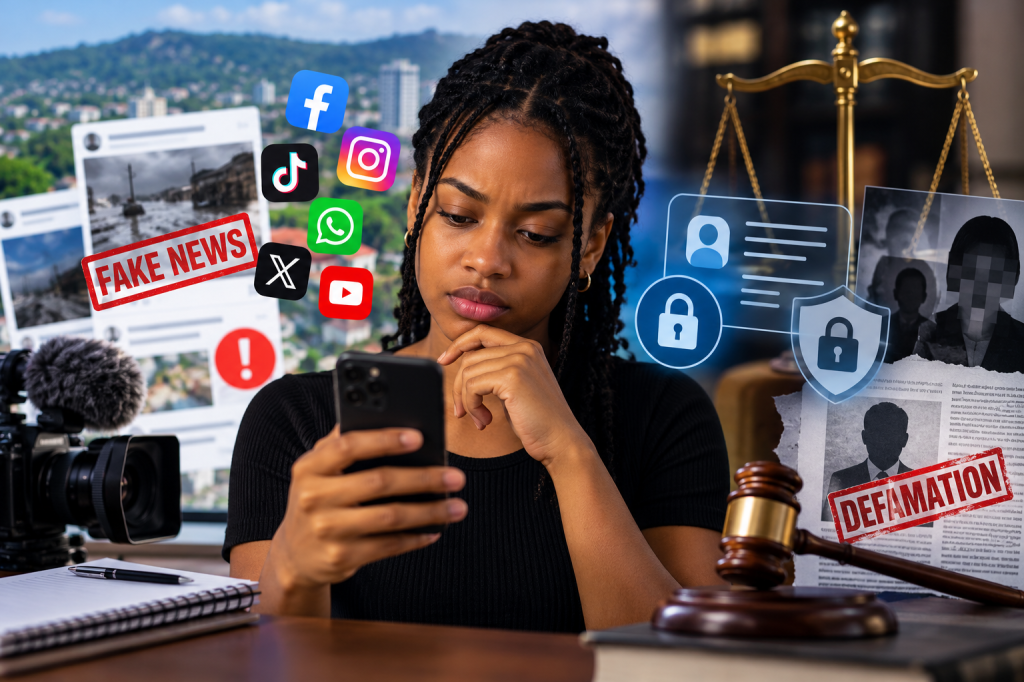
Social media has significantly changed how Jamaicans receive, share and discuss news. Platforms such as Facebook, Instagram, TikTok, Twitter/X and WhatsApp allow information to reach thousands of people within minutes. While this has made communication more accessible, it has also created serious ethical and legal challenges for journalists, content creators and everyday social media users.
In my opinion, the biggest problem is not the technology itself, but how responsibly people use it. Four issues that need special attention are: misleading information and privacy and confidentiality as ethical issues and privacy and data protection and defamation as legal issues, all of which affect everyone who publishes online.
Ethical Issue 1: Misleading Information – When Engagement Matters More Than Accuracy
One of the most concerning ethical issues surrounding social media and digital journalism is the spread of misleading information. Social media allows virtually anyone to become a publisher, regardless of whether they have the training or skills needed to verify information.
A clear Jamaican example occurred during Hurricane Melissa in October 2025. As the hurricane approached Jamaica, videos circulated on social media claiming to show the storm already devastating sections of the island. However, PolitiFact investigations revealed that some of the footage came from previous weather events in Italy, Mexico and the United States (Briceno, 2025).
What concerns me is that misleading information during a natural disaster can have consequences beyond social media engagement. People rely on accurate information to decide whether to evacuate, prepare emergency supplies or protect their families. Unverified information can create unnecessary panic and undermine confidence in legitimate warnings.
I believe digital journalists and content creators have an ethical responsibility to verify information before publishing it. This includes checking original sources, verifying images and videos, identifying AI-generated content and promptly correcting inaccurate reports.
Being the first person to post something means very little if the information turns out to be false. Credibility should always be more valuable than engagement.
Ethical Issue 2: Privacy and Confidentiality – Not Everything Should Be Public Content
Another ethical concern is the increasing disregard for privacy and confidentiality when sensitive information becomes available online.
In Jamaica, social media often features discussions of private disputes, criminal investigations, accidents, and vulnerable individuals. However, access to information does not mean someone should publish it.
In September 2025, the Child Protection and Family Services Agency (CPFSA) warned against sharing images or videos involving children experiencing abuse. The agency explained that circulating such material could cause additional trauma or lifelong stigma for the children concerned (The Gleaner, 2025)
This highlights an important distinction between public interest and public curiosity. People may be interested in viewing sensitive footage, but that does not automatically justify distributing it.
The responsibility is even greater for journalists who receive confidential information from sources. The Gleaner’s editorial code of ethics recognises the importance of protecting individuals’ privacy and maintaining commitments made to confidential sources (The Gleaner, n.d.).
Personally, I believe journalists and content creators should consider the long-term consequences of publishing sensitive material. A viral video might disappear from public discussion after a few days, but the emotional and reputational consequences for the individual involved could last considerably longer.
Journalists should therefore protect confidential sources, avoid unnecessarily identifying vulnerable individuals and exercise discretion when publishing sensitive images or personal information. Responsible journalism is not simply about revealing information; it also requires knowing when withholding certain details is the more ethical decision.
Legal Issue 1: Privacy and Data Protection – Personal Information Comes with Legal Responsibilities
While privacy and confidentiality concern ethical judgment, privacy and data protection also involve enforceable legal obligations.
Jamaica’s Data Protection Act, 2020, which became operational in relevant parts on December 1, 2023, establish a framework for protecting personal information. The legislation regulates how data controllers collect, process, store and disclose personal data.
According to the Office of the Information Commissioner (n.d.), the Act sets out eight data protection standards, including fairness and lawfulness, purpose limitation, data accuracy, and security safeguards.
These requirements are particularly relevant in an environment where businesses, media organisations and digital platforms regularly collect personal information.
In January 2026, the Office of the Information Commissioner reminded Jamaicans that they have a legal right to know what personal information organisations hold about them, why they process it, and whether they share it with third parties (Bartley, 2026).
For example, consider a Jamaican digital news organisation that collects subscribers’ names, email addresses and contact information. It must consider its legal obligations regarding how it obtains, secures, and uses that information. Sharing subscriber information with unauthorised parties could raise serious data protection concerns.
However, the Act also contains exemptions, including provisions relevant to journalistic activities, so whether a specific activity breaches the law depends on the circumstances.
My perspective is that organisations should not treat data protection as merely a compliance exercise. It should form part of their everyday responsibility to the people who trust them with their information.
The ability to collect personal information should never be mistaken for unrestricted permission to use or disclose it.
Legal Issue 2: Defamation – Freedom of Expression Does Not Eliminate Accountability
Social media has made it increasingly easy for people to publicly accuse individuals, businesses, and public officials of wrongdoing. Although freedom of expression is essential in a democratic society, it does not remove the legal consequences of publishing defamatory material.
In Jamaica, the Defamation Act, 2013 governs civil claims involving defamatory publications. The legislation abolished criminal libel while maintaining civil remedies for reputational harm. It also recognises legal defences, including truth and fair comment, subject to the requirements established by law.
A significant local example is Creary v. The Gleaner Company (Media) Limited (2025). In February 2025, Jamaica’s Supreme Court awarded Richard Creary J$10 million in damages after finding that a published article had defamed him. The case involved reporting connected to allegations of corruption and highlighted failures relating to verification and the opportunity for the affected individual to respond.
This case demonstrates why journalists must exercise caution when reporting allegations, even when their information comes from official documents.
The same broader lesson applies to social media users. Reposting accusations, presenting rumours as established facts, or making damaging claims without sufficient evidence can create legal risks.
In my opinion, freedom of expression should be protected, especially when exposing wrongdoing or holding powerful individuals accountable. However, there is a clear difference between expressing an opinion, reporting a verified fact and making an unsubstantiated accusation.
Before publishing potentially damaging information, Journalists and digital content creators should verify the underlying facts, distinguish allegations from proven findings and give affected individuals a fair opportunity to respond where appropriate.
Freedom of expression carries responsibility, particularly when another person’s reputation is at stake.
Conclusion
Social media gives Jamaicans a stronger voice, but that voice comes with responsibility. Misleading information can confuse the public, while careless sharing can hurt vulnerable people. Poor handling of personal data can break the law and false accusations can damage reputations.
My main message is simple: think before you post. Check information, respect privacy, protect personal data and be fair when discussing others. Technology may keep changing, but accuracy, respect and accountability should remain central to Jamaican digital journalism.
The Social Perspective Ep.2
References
Bartley, R. (2026). Data subjects entitled to know how personal information is used.
Jamaica Information Service.
https://jis.gov.jm/data-subjects-entitled-to-know-how-personal-information-is-used
Briceno, M. (2025). These clips don’t show Hurricane Melissa in Jamaica; they show weather
events from around the world. PolitiFact.
https://politifact.com/factchecks/2025/oct/27/tweets/hurricane-melissa-jamaica-videos/
Creary v. The Gleaner Company (Media) Limited, [2025] JMSC Civ 21 (Supreme Court of
Judicature of Jamaica, 2025). https://supremecourt.gov.jm/node/6994
Data Protection Act, 2020 (Jamaica).
https://laws.moj.gov.jm/legislation/aop/2/7_2020-The%20Data%20Protection%20Act.pdf
Defamation Act, 2013 (Jamaica).
https://www.japarliament.gov.jm/attachments/341_The%20Defamation%20Act%2C%202013.pdf
James, V. (2025). Minister Samuda cautions against tropical storm misinformation. Jamaica
Information Service.
https://jis.gov.jm/minister-samuda-cautions-against-tropical-storm-misinformation-2
Office of the Information Commissioner. (n.d.). Data protection standards.
https://oic.gov.jm/page/data-protection-standards
Office of the Information Commissioner. (n.d.). What are the obligations of data controllers?
https://oic.gov.jm/content/what-are-obligations-data-controllers
The Gleaner. (n.d.). Editorial code of ethics and professionalism.
https://past.jamaica-gleaner.com/code-of-ethics.html
The Gleaner. (2025). Children of TikToker Rosealee removed from home as part of ongoing
probe into alleged abuse – CPFSA.


Leave a Reply